


Mariposa Folk Festival co-founder Ruth Jones-McVeigh gave an enduring gift to Canadian music
Posted on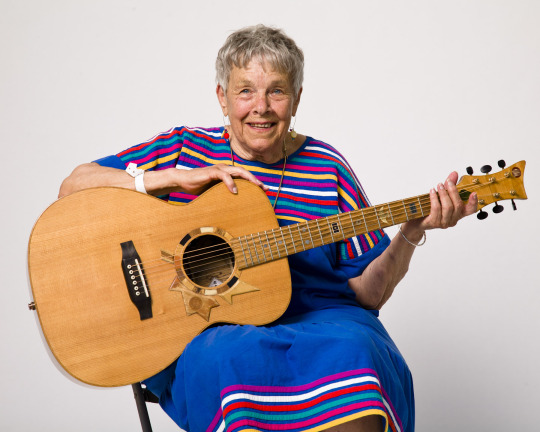
Photo credit: Doug Nicholson/courtesy of Six String Nation
Obituary written by Brad Wheeler – Globe and Mail, January 21, 2026
The concept was that the festival could support Canadian folk artists to forge a career in their own country instead of having to be first recognized in the United States. “We also want to make the people of Canada familiar with their own folk songs,” read Mariposa’s founding mission statement.
The inaugural 1961 edition at the Orillia Lions Oval featured an all-homegrown lineup of artists and introduced the word “hootenanny” to the squares. Some of the strummers and warblers, in addition to Ian & Sylvia, were Alan Mills, Bonnie Dobson, the Travellers and Jacques Labrecque.
According to a Globe and Mail dispatch, the youthful folkies preferred old tunes but with new words that damned the bomb and Jim Crow laws equally.
“These young people are concerned,” Ms. Jones-McVeigh told reporter Frank Marzan in 1961. “They seek through their songs to make the world aware.”
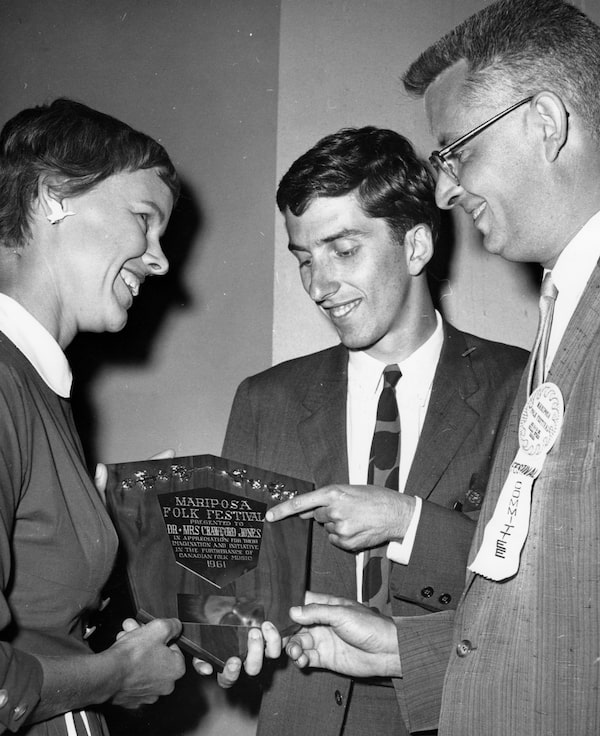
Ms. Jones-McVeigh and her then-husband, Crawford Jones, receive a plaque marking the first Mariposa Folk Festival in 1961.James Pauk/Mariposa/Supplied

Ruth Marjorie Mildon Major was born Dec. 20, 1926. She was one of two children born to Marjorie Major (née Freeman) and Phillip Major. The former was a New England-born journalist with the Halifax Mail and Halifax Mail-Star who lived to be 101; the latter was a military man who co-founded the Armdale Yacht Club.
As a teen, Ruth took piano lessons, crewed with her father on a sailing dinghy, was an equestrian with the Halifax Junior Bengal Lancers − she broke her collarbone once − and sang at St. Paul’s Anglican Church.
While working backstage with the theatre group the Atlantic Players in her 20s, she was introduced to the tall, dark-haired naval officer who would become her first husband in 1949.
When Dr. Jones quit the Navy for a career in psychiatry, the couple and their children headed to Toronto. They then moved 90 minutes north to Orillia, the bucolic hometown of Gordon Lightfoot where lakes Couchiching and Simcoe meet. Dr. Jones was a superintendent at Ontario Hospital School, one of the country’s largest mental institutions.
In staid Orillia, the couple stood out. At a beatnik theme party thrown by a neighbour, the other parents on the block arrived costumed in beards, turtlenecks and berets. Mr. and Ms. Jones came dressed as themselves.
The restless mother of four in her early 30s travelled to Toronto once a month to get her hair styled and visit the city’s folk music hub, the Village Corner.
On an ice-cold night at an old Orillia dance hall in January, 1961, CBC broadcaster John Fisher addressed the local chamber of commerce on the importance of small-town tourism. Ms. Jones-McVeigh was in the audience. Shortly afterward, while sick in bed with the flu, she decided a folk festival in Orillia would draw people and attention to what she considered a snoozy place.
Her vision took form at meetings held at the Clef Club in Toronto and the Jones’s rambling Victorian house on Lake Couchiching. Advertising man Ed Cowan and other members of the tight-knit Toronto folk community visited the Newport Folk Festival in Rhode Island and came back inspired.
Once Mariposa was announced, Ms. Jones-McVeigh gave press interviews, arranged for the local post office to place Mariposa stamps on the mail and had dairies attach promotional collars to milk bottles delivered to summer cottagers.
“With the innocence of youth and confidence,” she said in 2013, “I was absolutely certain it would be a success.”
It was. An estimated crowd of 10,000 caused the local police chief to cancel all leaves in his 13-member force to handle 3,000 automobiles. (The only bummer was that thieves broke into the car of Mr. Tyson and bass player Ian Henstridge and stole their stage clothes.)
“You could tell by the way she pulled that first festival together that Ruth was a force of nature,” said Michael Hill, former Mariposa artistic director and author of The Mariposa Folk Festival: A History.
The festival’s second edition built on the momentum initiated by the first. While many of the musicians from 1961 returned for 1962, newbies included the Two Tones (featuring a 23-year-old Gordon Lightfoot) and Ed McCurdy, a favourite of Ms. Jones-McVeigh best known for his anti-war song Last Night I Had the Strangest Dream.
An account of the festival by The Globe’s Betty Lee was unbridled: “More than 10,000 twangin’, swingin’, bongo-drummin’ folkniks jammed into this astonished and sleepless Couchiching town during the weekend to pay $40,000 into the till of the second annual Mariposa Folk Festival.”
Visitors hitchhiked from Manitoba and British Columbia and flew in from California. The jackets of college students advertised the universities of Toronto and Carlton in Canada and Cornell, Ohio State and Columbia south of the border.
“In 60 frenetic hours, the squads of folk-singing buffs ate out every soft drink and ice cream store in town and occupied every room in motels, hotels and lodges as far away as Barrie,” The Globe reported.
Ms. Jones-McVeigh’s idea for a melodic gathering and a tourism bonanza was validated. “Ruth was one of those figures of the pre-boomer generation who saw possibility where others saw problems,” said Michael Martyn, an Orillia resident and former executive director of the Festival of the Sound in Parry Sound, Ont.
Toronto businessman Jack Wall, who had bought the rights to the festival after the first edition, was pleased with his investment in Mariposa and Orillia. “I would say that we’re definitely here to stay,” he told The Globe in 1962.
That would not be the case. The 1963 Mariposa was marred by drunken hooligans who flooded the campsites but had no interest in the actual music. “I never saw anything more deplorable from the point of view of sanitation, morals, violation of the liquor [laws], and impossible traffic situations,” Ontario Provincial Police Sergeant Ken Chalmers told the Orillia Packet and Times.
In response to the fiasco, the Orillia City Council booted Mariposa out of town. The patchouli-scented festival would exist nomadically in Ontario for years, moving among Innis Lake, Barrie, Bracebridge and various Toronto locations before finding its way back to its ancestral home of Orillia for good in 2000.
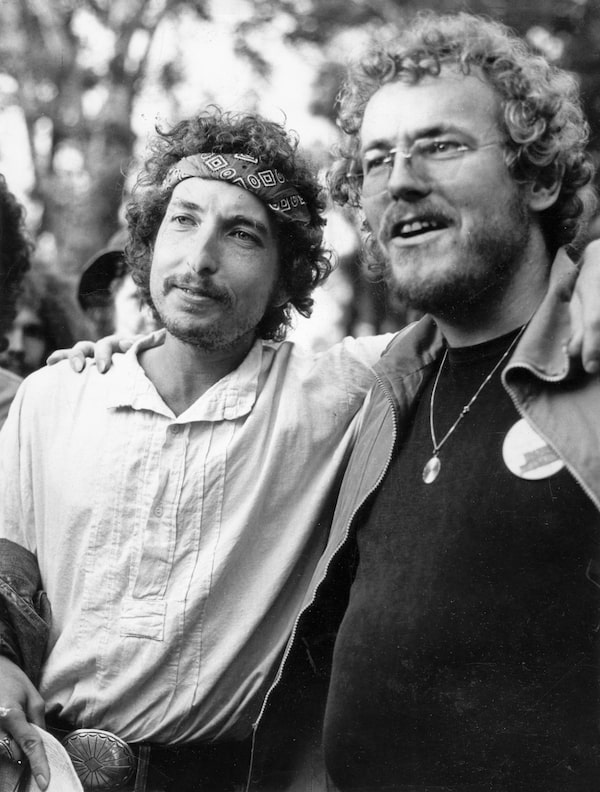
Bob Dylan, left, and Gordon Lightfoot attend the 1972 edition of Mariposa on Toronto Islands on July 16, 1972.Thomas Beames

After the third Mariposa, Ms. Jones-McVeigh resigned as the festival’s president. Her marriage was over as well. She and Toronto folk musician Doug (Bush) Johnston were living in New York in 1963 when U.S. president John F. Kennedy was assassinated.
“People walked along the street with tears streaming down their faces,” Ms. Jones-McVeigh wrote in her self-published memoir Shifting Ground. “Men, women, well-dressed, old bums, young hippies − it didn’t matter.”
She met her second husband, forester Terry McVeigh, in Vancouver. They exchanged vows in 1969. Her memoir documents a loving but tempestuous 22-year marriage that included time in Guyana and produced two children. (After the divorce in 1991, Mr. McVeigh was diagnosed with manic depression, now called bipolar disorder.)
In 1977, Ms. Jones-McVeigh co-authored Fogswamp, about the family of Ralph Edwards, the pioneering British Columbian homesteader and conservationist of the trumpeter swan. She wrote the book with Mr. Edwards’s daughter, Trudy Turner.
According to Ms. Jones-McVeigh, because the original manuscript by Ms. Turner was a bit rough, the publishers needed a writer to go to an isolated spot in Bella Coola, B.C., to help finish the book. Ms. Turner’s husband decreed that only a woman could work with his wife, and that the co-writer would need to tough it out it in the middle of winter in a dirt-floored cabin away from the main house, with only a deerskin for a door.
“I volunteered,” Ms. Jones-McVeigh would later write.
On Aug. 31, 1988, while working as an assistant to British Columbia MP Mr. Manly, the 51-year-old was ejected with others from the Opposition Lobby in the House of Commons for singing O Canada as the North American Free Trade Agreement bill was being debated.
Although she had not been officially affiliated with Mariposa since 1963 and stayed away until 1986, Ms. Jones-McVeigh visited the festival in her later years, enjoying the music and her revered status.
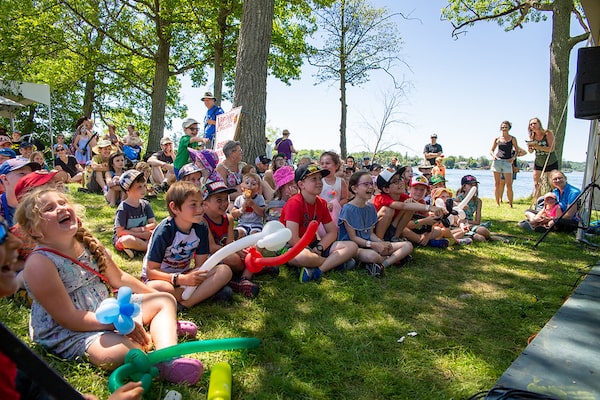

Today, the Mariposa Folk Festival has returned to its place as a fixture of Orillia summers.Deb Halbot/Supplied
“She was very protective of her legacy,” said former Mariposa president Chris Lusty. “Late in her life she wanted to make sure Mariposa was prominent and had a national reach.”
In 2013, she spoke with Mariposa organizers about the evolution of the festival and the new guard in charge.
“The old order changes, yielding way to the new,” she said. “As long as people are expressing themselves and loving each other, which is what happens at folk festivals.”
She leaves her brother, David Major; children, David Jones, Bruce Jones, Grace Solman, Barbara Vivian, Thomas McVeigh and Ilana de Souza; and grandchildren and great-grandchildren.
Editor’s note: Ruth Jones-McVeigh’s 22-year marriage to Terry McVeigh included time in Guyana, not Ghana. This version has been corrected.